

“Abuela” is the direct Spanish translation of “grandma” or “grandmother.” That’s the word you’ll usually find in Google Translate or a dictionary.
But if your grandma is Latina, or you have Spanish-speaking family members, you’ve probably heard many other words besides just “abuela.”
That reminds me of my friend Trevon.
His grandmother was from Puerto Rico, and she only spoke Spanish. Growing up, he barely talked to her because of the language barrier.
After she passed away, he regretted never making more of an effort to connect with her.
Maybe you can relate to that situation a little.
Maybe you want to communicate better with your Spanish-speaking family, understand the nicknames they use, or simply sound more natural when speaking Spanish.
If that’s you, this article will help.
Here are 14 ways Latino families actually say grandma in Spanish, the ones that make her smile when she hears them.
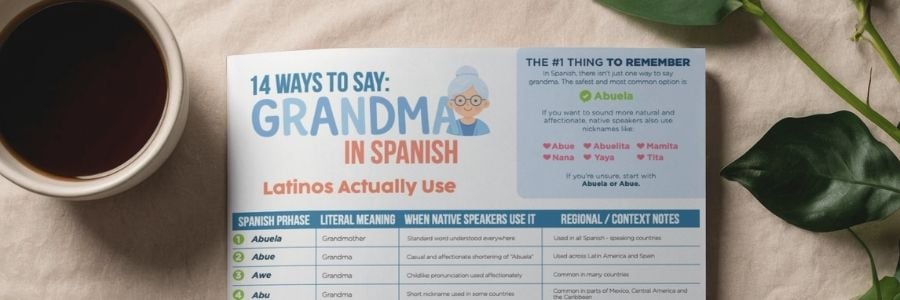
In a bit of hurry? Sign-up to my newsletter and download the PDF so you can review it later:
#1 The exact translation for Grandma in Spanish: Abuela

If you type “grandmother” in Google Translate, you’ll get “Abuela”.
This is the most common way to refer to the mother of one of your parents in Spanish.
People use it in all countries, and every Spanish native speaker understands this word.
These are a couple of examples using “abuela”:
- ¡Hola, abuela! tiempo sin verte: Hello grandma, long time no see!
- Mi abuela no ha salido de casa desde que inició la pandemia: My grandmother hasn’t come out of the house since the pandemic started.
Native speakers play with words all the time, which means that they may shorten words at any moment.
Because of that you may probably hear native speaker saying:
#2 Abue
“Abue” is just the short version of Abuela.
If you look at the word “Abue”, then you probably noticed that “La” is missing at the end.
People shorten words this way to send a message of feeling familiarity to the person they’re talking to.
They even do it with names, but that’s a whole different story.
Check out these examples:
- Mi abue es la mejor, ella me dio dinero para un helado: My grandma is the best, she gave me money for an ice cream.
- Mi abue dejó su bolso en mi auto: My grandma left her purse in my car.
#3 Awe
With this word native speakers play with the letter “b” in the word “abue”.
I feel like it’s a lazy way to avoid saying that letter.
Pronunciation is not as in the word “Awesome” in English, which I know is how you are reading it right now.
Spanish speakers pronounce it as AA-OO-EH.
It’s very common to hear children calling their nanas this way because they probably are not so skillful when they talk.
However adults keep using this word during their life, in an effort to express affection to their grandmothers. For instance:
- Hola Awe, ¿trajiste dulces hoy también?: Hi Grandma, did you bring candies today too?
- Mi awe me dijo que me iba a llevar de paseo cuando terminara la escuela: My grandma told me that she was going to take me on a trip when I finished school .
#4 Abu
Some native speakers may go a little further in shortening the word “Abuela”, to the point in which the word would miss “ela”
Again they do this just to create a message of affection.
To be honest, “Abu” isn’t a very common way to call your grandma in Colombia, but I’ve heard native speakers from other countries using it.
Here are some examples:
- Abu, ¿segura que te sientes bien hoy?: Grandma, are you sure you feel good today?
- Abu, no tengo hambre, ¡de verdad!: Grandma, I’m not hungry, seriously!
#5 Wela

“Wela” is another shortened and wrong-pronounced version of “abuela”.
It’s like if the person was skipping the “A” in “abuela” and saying only “buela”, but taking pressure off the “B”.
I know many Spanish teachers would say that this isn’t correct Spanish, and they’re right, but that’s how people talk in real life and you need to be ready to understand them.
Examples with “Wela”:
- Wela… ¿y por qué te enamoraste del abuelo?: Grandma… and why did you fall in love with grandpa?
- Wela, ¿quieres que te enseñe a manejar la tablet?: Grandma, do you want me to teach you to use the tablet?
Related:14 Ways to Say Grandpa in Spanish Latinos Actually Use
#6 Abuelita
People use lots of diminutives in Spanish, I mean they do it a lot.
Sometimes they do it because they want to express affection for what they’re talking about.
This is the case of the word “Abuelita”.
Some examples:
- Mi abuelita hace los mejores frijoles de toda la historia humana: My grandma makes the best beans ever.
- ¿Viste que mi abuelita me trajo un regalo? ¡Cómo la amo!: Did you see that my grandma bought me a present? I love her so much!
#7 Lita
After learning the word Abuelita, you have to know that native speakers also shorten tis word.
This time notice that we’re skipping “abue” and leaving “Lita” as a nickname to say grandma in Spanish.
Children are the ones who make this mistake the most, but sometimes adults use it too in an effort to keep that “affection” for grandma.
Some examples:
- Lita, ¿Cuántos años tienes tú?: Grandma, how old are you?
- Seguro que cuando llegue mi hijo, va a empezar a preguntar por la Lita: Make sure that when my son comes home, he’s going to ask about his grandmother
#8 Agüelita
Perhaps Spanish teachers will hate me for teaching you this word, this is a mistake locals in Colombia make every day.
People who say this, are especially people who don’t have much education.
Also, it’s very common to hear little children with pronunciation problems saying it.
Should you use it? No, please don’t.
Just be aware that you may hear it from native speakers.
It’s very normal to hear them saying that and even using the shortened versions undo word which will cover later for now here are tell me examples:
- Yo vivo con mi agüelita en la finca:I live with my grandma in the farm
- A mi mamá le toca cuidar a mi agüelita porque yo todavía estoy muy pequeño:I have to take care of my grandmother because I’m still too young
Anyway…
So far, we’ve covered different ways in which native speakers play with the word “Abuela”.
They shorten it, divided it, and even “slice” it into pieces. 😅
Let’s go now through some of the nicknames that people usually give their grandmothers:
#9 Mamá + the grandma’s name

Yes, “mamá” means mother, but that’s also a nickname for grandmother.
People who say this want to communicate that their grandmother is as respected and loved as their own mothers.
This is actually how my mom refers to her grandmother when she talks about her.
Here are some of the phrases my mother says when she remembered her grandma:
- La mamá rosa preparaba un dulce de papaya excelente: Rosa, my grandma used to prepare an excellent papaya dessert.
- La mamá rosa se enojaba mucho porque los niños hacían mucha bulla: Rosa,
- My grandma used to get very angry because the kids were very noisy.
#10 Mamita
Another nickname to call your grandmother is “Mamita”, which is a diminutive for Mom.
Just as #9, If you’re using this word, you’re referring to your grandma as if she was your mother.
This one, however, gives the grandma a little more affection because it uses a diminutive.
It communicates that you consider your grandma a loving and sweet person.
I think only Colombians use this nickname, though I may be wrong. If you know about other countries using it, let me know in the comments.
Some examples:
- Hola hijo, ¿ya saludaste a la mamita?: Hi son, did you say hi to Grandma already?
- La mamita no tiene hambre, ella dijo que prefería un postre en vez de sopa: Grandma isn’t hungry, she said she preferred a dessert instead of soup.
#11 Mita
This is the shortened version of “Mamita”.
As you can notice, we skip “Ma”, and the only thing we say is “Mita”
Here are some examples:
- Mita, ¿le traigo los audífonos para que escuche mejor?: Grandma. Do you want me to bring you the headphones so you can hear better?
- ;ita, ¿si vio que mi hermano me robó la pelota que usted me regaló?: Grandma, did you see that my brother stole the ball you gave me?
#12 Nana
“Nana” is an old word native speakers use to say Grandma in Spanish with a touch of affection.
Honestly, I don’t hear it very often. Perhaps it is the region in which I live because it isn’t very common in my area.
For instance:
- Mi nana me enseñó que uno no debe escuchar a los extraños: My grandma taught me that I shouldn’t listen to strangers
- Mi nana nos cuidaba mucho, más que mi mamá: My grandma used to take care of us a lot, more than my mother.
Another way to use this word is to talk about a woman who’s hired to take care of kids, and clean a house.
#13 Yaya
This is another nickname to show affection to your grandmother.
People use it in both Spain and Latin America.
However, if you want me to be honest I’ve never heard it in Colombia and I’ve never used it with any of my grandmother’s.
Some examples:
- Hay que limpiar la casa porque la yaya viene de visita y a ella no le gusta el desorden: I have to clean the house because grandma is coming to visit and she doesn’t like the mess
- La yaya está muy triste porque le dijeron que el banco ya no le prestaría dinero: Grandma is very sad because they told her that the bank wouldn’t lend her money anymore.
#14 Tita
The word “Tita” is another way of referring to your grandmother as you express affection for her.
A common way of using it is using the article “La”, as if the grandma was an object.
An object you love I guess. 😅
It’s kind of a lovely nickname to say Granny. For Examples:
- La tita dijo que fuéramos a almorzar a su casa mañana: Grandma told us to go to have lunch to her house tomorrow.
- Vamos a ir a la boda con mi hermana, mi mamá y la tita: We are going to the wedding with my sister, my mother and my Grandma.
Sign up for my newsletter and download all these phrases in a printable pdf:
Conclusion
As you can see we have many different nicknames to call your grandmother and communicate affection for her.
I know that many of these 14 ways to say grandma in Spanish don’t make much sense in English, but it makes total sense in Spanish.
That’s how native speakers say grandma in Spanish, and it’s important that you know those words so you can understand when they talk.
To sum-up, the most common and acceptable ways to say grandma in Spanish are:
- Abuela
- Abue
- Mamita (in Colombia)
Depending on each country you may hear other words being popular too.
Other not so popular ways to say grandma in Spanish among natives that I feel need to be mentioned in this article are:
- Nani
- Tata
- Nona
- Gueli
- Nena
- Licha
Here’s an infographic I made, so you can quickly access this vocabulary.
Who knows… perhaps you’ll hear any of these words in your next trip to Colombia…

One More Thing Before You Go
Now you know what to call her. But the moment you walk into that room, you’ll need more than a name.
What do you say when she offers you food? How do you tell her the meal was incredible? How do you say goodbye in a way that makes her feel like you’ll actually miss her?
Those are exactly the kinds of phrases in my free guide:
101 Phrases Native Spanish Speakers Use Every Day.
Real expressions for real family moments, the kind that make people feel like you actually get their culture.